AlertOps ingests every signal from every monitoring tool, eliminates noise with OpsIQ Smart Correlation, and routes only what matters to the right engineer.
Demo personalized to your monitoring stack.
Alert noise is not a volume problem. It is a signal quality problem. When every downstream symptom of a single root cause fires as a separate alert, your engineers spend more time triaging than resolving.
Your Datadog, Prometheus, and CloudWatch instances alert independently on every symptom of the same failure. Engineers wake up to a storm and spend 20 minutes reconstructing what actually broke.
Without intelligent routing, every alert goes to whoever is on-call regardless of expertise, severity, or source. The result is engineers resolving incidents outside their domain while the right SME sleeps.
You have Datadog. You have Prometheus. You have CloudWatch. They all fire independently with no shared context. Without a correlation layer, you have detection without intelligence.
Alert management is not just about receiving signals. It is about transforming raw signal volume into actionable, contextualized incidents that arrive with a resolution path.
A raw alert string from one tool. 14 similar strings from two other tools. No correlation. No context.
One correlated incident with root cause hint, historical match, and suggested fix. Ready at page time.
Every alert passes through. Maintenance windows require manual configuration. Flapping alerts page repeatedly.
Deduplication, suppression, flap detection, and maintenance window controls. Engineers see what matters.
The alert ages out or sits in a queue. MTTR climbs. The issue compounds.
Automated escalation fires through every configured channel until the incident has an owner.
AlertOps centralizes signal ingestion, correlation, routing, and escalation in a single system. 200+ integrations. No context switching.
Your Datadog, Prometheus, and CloudWatch instances are firing independently on every symptom of the same failure. AlertOps ingests every signal, normalizes it, and runs OpsIQ Smart Correlation so your engineers see one actionable incident instead of 14 screaming alerts from three different tools.
Intelligent routing means a SEV-1 from Datadog at 2am reaches the right SRE via voice call, not a Slack message they will see at 9am. AlertOps routing logic is severity-aware, source-aware, and schedule-aware configured once, runs forever.
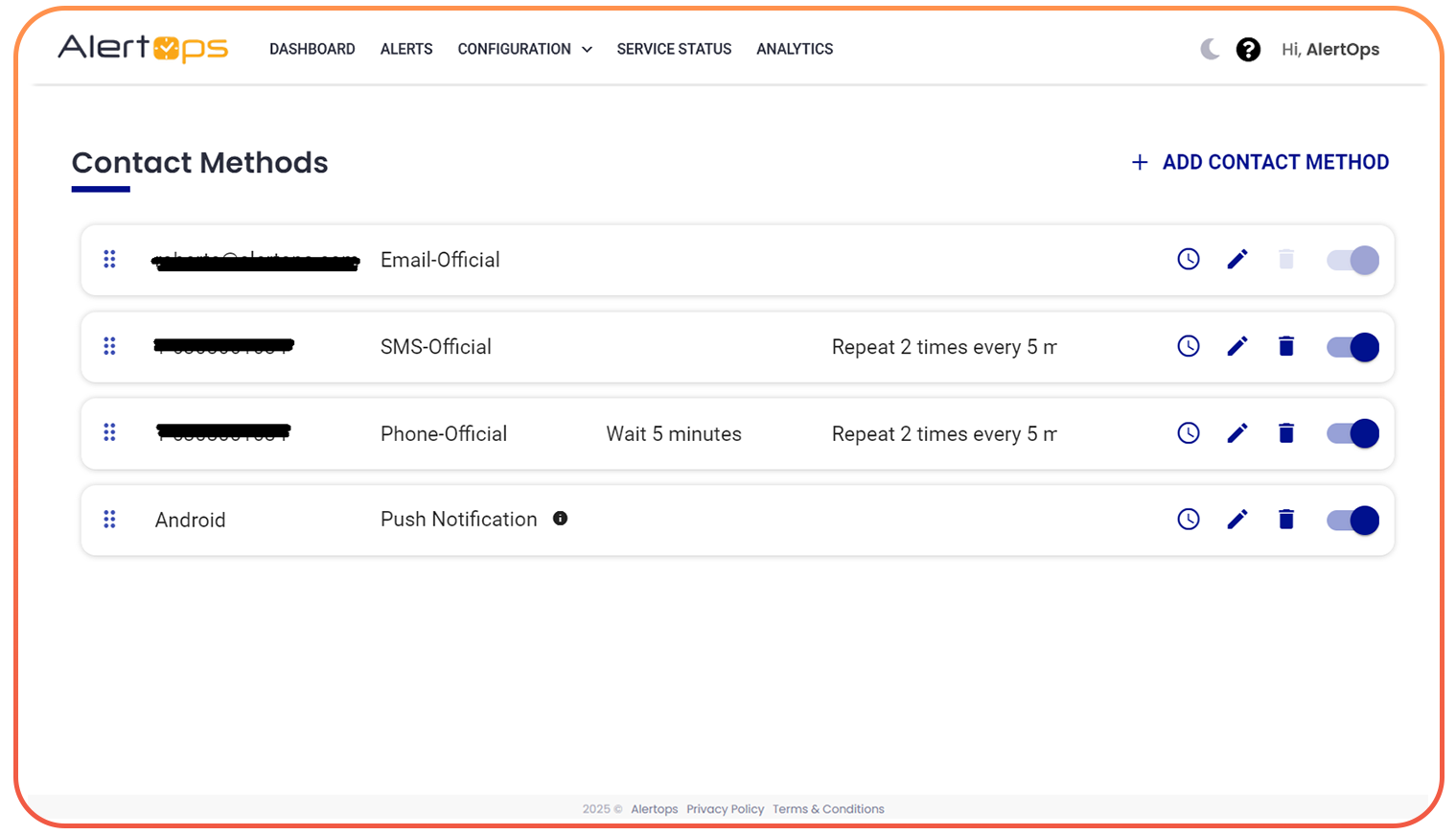
A P1 needs a phone call. A warning can go to Slack. AlertOps delivers the right alert through the right channel with the right content OpsIQ-enriched context so engineers arrive informed and ready to resolve.
OpsIQ does not just pass alerts through a routing table. It understands them, groups them, enriches them with context, and routes only the signals that genuinely need a human with the resolution path already mapped out.
4 alerts collapsed to 1 incident. Root: DB connection pool on rds-prod-01. 1 unrelated alert suppressed. Routed to Sarah K. (SRE Primary). Time saved vs manual triage: approx. 14 minutes.
The difference between a 4-minute resolution and an 18-minute one is not engineer skill. It is whether the alert management layer does the triage work before anyone is paged.
Datadog, CloudWatch, and Prometheus all fire independently. No correlation. Engineer wakes up to a storm with no context.
Engineer pieces together the incident manually. Root cause still unclear. Nothing is fixed. MTTR clock is running.
Routing is based on the on-call schedule, not expertise. Right SME is not paged. Handoff required.
Resolution eventually happens. No timestamped record. Same incident next week.
OpsIQ groups signals from Datadog, CloudWatch, and Prometheus. 1 unrelated alert suppressed. One incident. One resolution path.
OpsIQ delivers correlated incident, root cause hint, historical match, and suggested runbook. Triage work done before the page fires.
Severity-aware, source-aware, and role-aware routing reaches the correct SRE via voice call in under 90 seconds.
Resolution confirmed. Every action timestamped. Chronicle Postmortem auto-generated. Next time is even faster.
AlertOps plugs into your existing monitoring, ITSM, and ChatOps stack. Replace only the incident layer. Keep everything else exactly where it is.
AlertOps connects to your existing tools in hours. OpsIQ AI starts reducing noise immediately. No rip-and-replace. No long deployment cycles. 14-day free trial on every plan.